

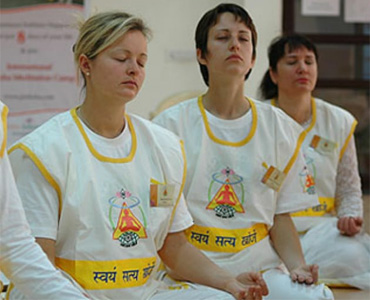
Yogasan, the yogic exercises are an essential part of Preksha meditation. Until and unless the body is put into a relaxed, still and steady posture, one fails to achieve deep state of meditation. According to the Jain yoga practices, in the beginning, one should perform the yogic exercises on the floor in a lying posture that requires less energy. Subsequently yogic exercises in sitting and standing postures may be performed which increases the levels of energy consumption.
The main objectives of yogic exercises are as under:
Physical exercise, is included in Preksha Meditation to bring about positive transformation in our personality. It is believed that improper way of meditation sometimes may adversely affect the digestive system and make it inefficient and dull. Yogic exercises if performed along with meditation have the ability to neutralize this effect. Simultaneously performed meditation and yogic exercises can help to control our emotions through the awakening of the various psychic centersand regulation of the endocrine system. For example, Sashankaasan can prove helpful in controlling anger. Similarly, a combination of meditation and different yogic exercises such as padmaasan, vajraasan, sukhaasan may provide multiple benefits to the practitioner.
Aerobics is undoubtedly extremely helpful in promoting physical fitness. But it creates a tension in muscular system, which in long term can cause problem. However, yogic exercises offer several additional benefits to the practitioner if done accurately and are therefore, superior to aerobics in the following manner.
In general, the yogic exercises offer following long-term benefits:
For yogic exercises, it is absolutely essential to select appropriate place, apparel, time, and right technique.
A clean, serene, and well-ventilated location is desirable. Avoid a damp, dirty or polluted place. One should wear loose, light, and comfortable clothes. It is recommended to perform all types of yogic exercises on a thick blanket in order to avoid the loss of energy.
In general, yogic exercises are performed early in the morning. However, few yogic exercises can also be done safely 3-4 hours post meals. Different rules apply to different yogic exercises. So it is advised to perform them under proper guidance. Vajraasan can be practiced immediately after meal but not sarvangaasan. Similarly, the duration of different yogic exercises vary with the type of the exercises, age, and physical condition of the practitioner. In general, 20-30 minutes are sufficient for most of the yogic exercises. Although, the practitioner may choose to take breaks in between and perform particular exercises for 5-10 minutes in a session, it is absolutely essential to maintain a daily routine. If we are unable to find sufficient time to perform specific exercises for every part of the body, we must at least pay daily attention to the five most important parts of our body viz. brain, backbone, heart and lungs, abdomen, and the feet.
(For more details, refer Preksha Meditation : Yogasana and Pranayam)
A regular regime of a combination of yogic exercises is a safe, sure, versatile, and scientific way to promote physical, mental, and spiritual well being. The applicability is not limited to any particular factors. Hence can be performed by one and all.
Mindful meditation is a transformative practice that encourages you to live in the present moment, Default cultivating awareness and inner peace. By focusing on your breath, body, and surroundings, it helps quiet the mind, reduce stress, and bring clarity to your thoughts.
Copyright © 2025 All Rights Reserved.